Tampilkan postingan dengan label Hungary. Tampilkan semua postingan

Matches of the Century: World Cup 1954 Hungary Uruguay

Semi-Final
Stade La Pontaise, Lausanne
Wednesday, 30 June 1954 
Attendance: 37,000
Referee: Benjamin Griffiths

Overwhelming favourites to win the 1954 World Cup, Hungary arrived in Lausanne for their semi-final against Uruguay having suffered only one defeat in the preceding four years. Their opponents were defending champions, and had never lost a World Cup match in their history, winning both previous tournaments they had entered. One record had to give, and the stage was set for a match which would go down in history as one of the greatest football matches ever played.


Codec H264, Mkv
Resume 41mnts
540mo


Hungary were without their biggest star Ferenc Puskas, who had been injured in the group stages, but still started much the brighter side on a pitch left very heavy by rain earlier in the day. Just before the quarter-hour mark, a flick-on in the penalty area fell to Zoltán Czibor who placed his shot into the back of the net to give the Europeans the lead. Uruguay gradually managed to fight their way back into the game, but were unable to even the scores before half-time and went into the interval still trailing 1-0.


Almost immediately after the restart, Uruguay's grip on their title was loosened even further. Hungary seized on a poor defensive clearance and when the ball was launched into the box, Nandor Hidegkuti dived for a ball which seemed to be out of his reach and was just able to make contact with it, heading his team into a 2-0 lead. Uruguay's unbeaten World Cup record seemed to be over, but they still had nearly a full 45 minutes to recover.


The match went into extra-time, but any thoughts that the Hungarians would be demoralised by the loss of their two goal lead quickly evaporated. Appearing to have much more energy left than their opponents, Hungary retook the lead midway through the second period of extra-time when Sandor Kocsis headed home from close range. This time, the fading Uruguayans had no reply when Kocsis again got his head to a cross four minutes from time, the contest was over. Uruguay were beaten 4-2, their first ever World Cup loss, while Hungary went on to their second final where despite taking an early 2-0 lead they were surprisingly beaten 3-2 by West Germany.

Matches of the Century: World Cup 1954 Germany Hungary

Final
4th July 1954

Wankdorf Stadion, Bern

Attendance: 60,000
Referee: Willy H.E. Ling (England)


 West Germany: Turek, Posipal, Kohlmyer, Eckel, Liebrich, Mai, Rahn, Morlock, O. Walter, F. Walter, Scäfer
Hungary: Grosics, Buzanszky, Lantos, Boszik, Lorant, Zakarias, Puskas, Kocsis, Hidegkuti, Czibor, J. Toth
Goals: 0-1 Puskas (6), 0-2 Czibor (8), 1-2 Morlock (10), 2-2 Rahn (18), 3-2 Rahn (84)


Everyone expected Hungary to wipe the floor with Germany again and it looked to be a dead cert when they rapidly went two goals ahead. However, in remarkable scenes, the "Miracle of Bern" revealed itself to the stunned crowd. Within a ten-minute spell, the Germans had equalized through goals by Max Morlock and Helmut Rahn and had rocked the Hungarians.
The game was deadlocked until the final six minutes. After a tense moment when the Hungarians hit the post, Rahn made history by scoring the winner for West Germany after the Hungarian keeper had slipped on the turf. West Germany were World Champions for the first time.


Codec H264, Mkv
Bild Version, German

 
 or (interchangeable links)

A very confident Hungarian side ran on the pitch in Berne for the 1954 World Cup final in Berne, Switzerland: they had not lost a match in four years, and in the four previous matches to reach the final had scored a staggering 25 goals, among them, an 8-3 victory against the other finalists, West Germany, in the first round of the tournament.
In that match the Germans, under the legendary coach Sepp Herberger, had nevertheless lined almost only subsitute, not wanting to face Brazil in the quarterfinals, and also played a harsh match to injure the biggest Hungarians stars, notably Ferenc Puskas, who was unable to play until the final.
The Uruguayans in the semifinal had also shown that the mighty Hungarians could be shaken by strong fight and a solid defense, so the Germans went into the final as confident underdogs, willing to play their chance, after defeating Yugoslavia 2-0 in the quarterfinals, and destroying their Austrian brethren 6-1 in the semifinal. Among the German stars were the captain Fritz Walter, the legenderay Nüremberg striker Max Morlock, and the striker Helmuth Rahn, who was only called up by Sepp Herberger after the tournament had started.


The Hungarians decided to line up a not wholly recovered Ferenc Puskas for the final, which demanded some changes in a team that until then had been quite solid, but may have proven fatal seen in hindsight against a very solid German team.
However, none of this seemed to matter as the match (which was the first World Cup final that was transmitted live on TV) started: within eight minutes Hungary was up 2-0 on goals by Ference Puskas and Zoltán Czibor, the second goal being a huge mistake by the German goalkeeper Toni Turek.
The Hungarian goals just seemed to make the Germans better though. Within ten minutes Max Morlock and Helmuth Rahn had brought balance to the match, and the Germans dominated the rest of the first half, and things were looking good for the Germans, although nobody really thought that the Hungarians could lose!
Hungary did attack feverishly in the second half, but the Germans defended heroically, and in particular Toni Turek seemed impenetrable on the goal.


Only six minutes before the end of the match Helmuth Rahn received a return ball at the edge of the German area, made one quick move around a Hungarian defender and shot hard and flat towards the lower right goal-corner.
The German commentators screams of “TOOOOOR!” are legendary among commentators.
This remains one of the most legendary goals in German history, as it gave the West Germans the impossible victory against Hungary.
The victory meant a lot for Germans, who had been stygmatised after WWII (they had not even been allowed to participate in the 1950 World Cup), but this gave them something to be proud of, and came to symbolize the recovery of a nation. It was recreated in a 2003 German movie with huge succes, “Das Wunder von Bern” (“The Miracle of Bern”).
Germany has since remained one of the mightiest football nations in the world.


The situation was completely different for the Hungarians. The Hungary team of 1954 is arguably one of the best teams in the history of football, and surely the best team never to become world champion. Many of the players from the team had many excuses after the match, from a bad referee (who had disallowed a Puskas-goal for off-side in the dying second of the match), to drugs and black magic.
But truth is that on the day, the German fighting spirit was the best, something that is surely more important to win a World Championship.
The Hungarian “Dream Team” was soon to be dissolved because of the Hungarian Uprising of 1956, when most of the players went into exile, such as Kocsis, Puskas, Czibor. Hungarian football, that gave the world such a team, never really recovered from these events.


Les spectateurs parient que la magie des Magyars opérera une nouvelle fois et, en effet, la Hongrie mène rapidement de deux buts. Mais, en dix minutes légendaires, les Allemands renversent la vapeur. Et le meilleur reste à venir... Après une frappe sur le poteau des Hongrois, Helmut Rahn inscrit le but gagnant pour l'Allemagne à six minutes du coup de sifflet final. Il est bien aidé par le gardien hongrois, Gyula Grosics, qui glisse sur l'herbe mouillée et offre le match à la Mannschaft. Cette scène qui devait marquer l'histoire de la Coupe du Monde de la FIFA se déroulait au stade Wankdorf à Berne, le dimanche 4 juillet 1954. Pour les Allemands, cette première victoire en Coupe du Monde de la FIFA devait annoncer d'autres succès, comme l'histoire le démontra plus tard.


Reviews 

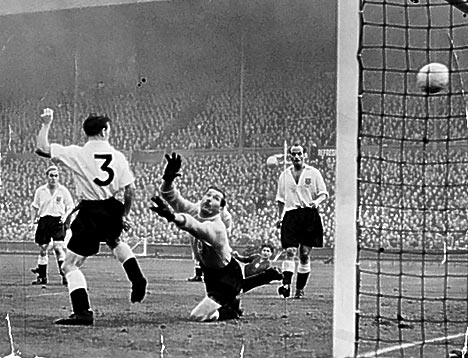
Matches of the Century: England Hungary Friendly

22 November 1953
Wembley Stadium
Attendance: 105,000
Referee: Leo Horn (Netherlands)
Hungary 1ere Nándor Hidegkuti 0-1, 20eme Nándor Hidegkuti 1-2, 24eme Ferenc Puskás 1-3, 27eme Ferenc Puskás 1-4, 50eme József Bozsik 2-5, 53eme Nándor Hidegkuti 2-6
England 13eme Jackie Sewell 1-1, 38eme Stanley Mortensen 2-4, 57eme Alf Ramsey 3-6
England Merrick - Alf Ramsey, Eckersley - Billy Wright, Johnston, Dickinson - Stanley Matthews, Taylor, Mortensen, Sewell,Robb - Coach Walter Winterbottom
Hungary Grosics Gellér (76eme) - Buzánszky, Lantos - Bozsik Lóránt, Zakariás- Budai, Kocsis, Hidegkuti, Puskás, Czibor (Coach Gusztáv Sebes)


England had never lost at Wembley to overseas opposition ? until the Mighty Magyars came to town ? and this was expected to be another routine victory for Walter Winterbottom's men. But his side were outplayed by a Hungary side whose potent mix of tactical trickery, short and long passing and superb technique left the 100,000 fans shell-shocked. Tom Finney, watching from the stands after being dropped, said: "I came away wondering what we had been doing all those years."


http://en.wikipedia.org/wiki/England_v_Hungary_%281953%29


During this era, Hungary was composed of six world-class players; a team creation of the Deputy Sports Minister Gusztáv Sebes in an endeavor to further collective sporting excellence in communist Hungary. Innovations included an approximation towards a precursor to "Total Football" many years ahead of the Dutch 360-degree strategy and the advent of the crucially important "playmaker" station, that resulted in the famed Hungarian W-attack with three forwards (one a deep-lying striker) and two slightly receding wings. The Hungarian team was unbeaten since May 1950 and dominated the 1952 Olympics in Helsinki.

A match was arranged later that November in 1953 that would have game-changing implications to prevail upon old insular normative beliefs to inspire football theory onward. It would precipitate a re-shaping of new core footballing ideas and displace minimally for half a generation football's centre of gravity; to occur was a immense collision between football's contemporary masters — the Magical Magyars and the venerable aristocrats of the game.
The English had invented the modern game in last half of the 19th Century. Its first laws and rules patented by a solicitor by trade Ebenezer Cobb Morley, and soon grew immensely popular across all spectrum of society due to its simple rules and minimal equipment requirements, being globalized as the world's most popular association sport in the last decade of the 19th century and early 20th centuries.


Since the codification of football in 1863 in Victorian England, the English national team had never suffered defeat on its home shores from foreign opposition from outside the British Isles, and their successful tradition had been penultimate and globally decisive. The old producers of football had turned aside every effort in 90 years to overcome the mightiest team of them all. This proud long reign of invincibility knit to semi-mythology was legendary, embedded into socio-national consciousness and ethos as a redoubt and post to which Englishmen could view with surety and confidence in spite of all forecasts, vicissitudes and the ever-changing times. Gorgeous, wonderful, and victorious English football possessed a feel of unbeatable quality and romantic neo-imperial Victorian inheritance with a direct unbroken connection to the palmiest days of the British Empire.

The British press, in building out the game that lay ahead, galvanized worldwide radio and newsprint audiences naming it the "Match of the Century", and a visit towards both teams' theoretical power, the media's remark of the match taking on world significance as "the world championship decider" — was a very becoming view considering the acme strength of both nations. England was ranked No. 3 in the world with a rating of 1943 points or the No. 2 best team in the Old World (Argentina  being ranked No. 2 with 2048 points), Hungary was ranked No. 1 with a rating of 2050* points. The anxiously promising match was ever England's sternest challenge to stem a gathering juggernaut from across the Channel from behind the Iron Curtain  that had remained unbeaten for over three and a half years — and in deference to a remarkable tradition, un-trampled power in Europe and treasured home record England would have its place in the sun again as the highly approved side. (wikipedia)


Ferencvaros Leeds United Uefa Cup 1967 1968

Final 
Second leg
Nep Stadium
11 September 1968
Refere: G.Schulenberg
Attendance: 76,000

Originally, the Final was supposed to be played the following week, but the Warsaw Pact's invasion of Czechoslovakia earlier that year now led to a lengthy delay and even the prospect of the tie being declared void. Many clubs can claim ail manner of bizarre reasons for post-ponements. Indeed, the subject has become the staple of radio phone-in shows over the last few years - but few could boast that the intervention of General Secretary Brezhnev and Cold War tensions almost handed them a European trophy on a plate. Revie and the Hungarians were adamant that the game should go ahead, and once UEFA, or EUFA as it was still known in the UK, had withdrawn their provocative proposai to segregate Eastern and Western European teams in future, the match was officially sanctioned for the second week in September. It turned out to be the most valiant performance in the club's history.
The common view beforehand was that Ferencvaros, probably the best team in Europe according to Bill Shankly and Sir Matt Busby, would humble United in Budapest's NEP Stadium. Leeds, however, put on a resolutely defensive display, which saw ail ten out-field players entrenched between the penalty area and the half-way line for prolonged periods of the game. Jones, at the apex of this system, gave the lead by harrying ail four Ferencvaros defenders, with the two wingers Hibbitt and O'Grady tucking in to pack the mid-field. Attacking play was restricted to set-pieces and the occasional unsupported foray from Jones or Lorimer. Leeds were too preoccupied with fortifying Sprake's goal to hazard even two players up front to try to extend their lead. Initially, the Hungarians played smoothly, passing the bail around, creating space, trying shots, but once Cooper had acrobatically cleared off the line and Sprake, enjoying the fines! game of his perversely variable career, had thwarted fine attempts from Albert, Szoke and Novak, they abandoned their natural game.

For much of the second half Ferencvaros continued to carve out chances. Yet United kept their nerve, with Sprake, briefly hereafter known as 'the Hero of Budapest', showing why Revie kept faith with him in spite of his famous blunders. Thus, already eight games into the following season, the team finally put the previous one to bed by becoming the first British club to win the Inter-City Pairs Cup, an achievement that had the Sketch's correspondent, a certain Mr J. Bean, extolling them as 'the most professional side ever to cross the chan-nel'. After collecting the trophy from Sir Stanley Rous, President of the Pairs Cup Committee, the United party, led by the Earl of Harewood, celebrated back at their hôtel with the press corps and the solitary fan who had hitch-hiked his way to the game. It was the cus-tomary Leeds knees-up, a few drinks and everyone doing their party piece, ail 'Cushy Butterfield' and 'Ilkla Moor'. By the time they got home the following day there had been a sea-change in the way they were perceived. Having donc to foreigners what they had done to domestic opposition for years, they had finally become accepted by the English press, as much for their spirit as for their prowess. Desmond Hackett of the Daily Express, usually a critic, wrote: 'When tired limbs screamed rebellion over extra exertion, there was not one Leeds player who failed to drive himself in that f'urther yard of effort.' This sort of acclamation had been long overdue.
Ten thousand fans turned up on the Headrow to welcome Leeds home. At the reception the Mayor, partaking in the party atmosphere, made light of his disability by conducting the communal singing with his crutches. Once the players had gone into the Town Hall for the banquet, however, 300 supporters embarked on a mini-riot, tram-pling flowerbeds, stopping traffic and chanting obscene songs...


Ferencvaros: Geczi, Novak, Pancsics, Havasi, Juhasz, Szucs, Rakosi, Szoke (Karaba 60), Varga, Albert, Katona
Leeds: Sprake, Reaney, Cooper, Bremner, Charlton, Hunter, O'Grady, Lorimer, Jones, Madeley, Hibbitt (Bates 68)

Review : http://www.mightyleeds.co.uk/matches/19680911.htm


European Cup 1968 1969 Ajax Amsterdam Spartak Trnava


Semi Final
First Leg
Olympic Stadium, 
Amsterdam
23 April 1969


The 1968–69 season of the European Cup football club tournament was won by Milan, who beat Ajax 4–1 in the final, giving Milan its first European Cup title since 1963, and its second overall. A number of Eastern European clubs withdrew from the first two rounds when UEFA paired up all of the Eastern European clubs against one another.


Resume


The Golden era of Spartak began in the season of 1966/67. The team of legendary coach Anton Malatinský was top of the league by autumn, but by the end of the season had only finished in third place. Great success was achieved in the Mitropa Cup. Spartak beat teams like Budapest Honvéd FC, S.S. Lazio and ACF Fiorentina and in final the defeated Újpest FC of Hungary. In the following season Spartak gained their memorable first title. They reached the semi-final of European Cup to face Ajax Amsterdam. It is their greatest success up until now. Under the management of Ján Hucko, the team also won a second championship. In 1970/71 and 1971/72, Trnava won their third and fourth championship titles under coaches Valér Švec and Anton Malatinský. The team also reached the quarter-final of European Cup in 1973 and 1974. The fifth and the last league title in 1972/73 beckoned the end of Spartak's golden era.


Uefa Cup Finals 1968 1969 Newcastle vs Ujpest Dozsa Both Legs

Finals
First and Second Leg
 Newcastle, the club who got into the Fairs Cup although finishing only 10th in Ihe First Division last season, have confounded everyone and won it. They wenl to Budapest with a 3-0 lead from the first leg of the final and proceeded to beat Ujpesl Dozsa again, this time by 5-2.
Newcastle's "back-door" qualification came about because of the "one city, one team" rule in the Fairs Cup (which precluded Everton, Spurs and Arsenal): the increase in England's entry to four clubs; and Ihe participation of Manchester United and West Bromwich, respectively, in the Champions' Cup and the Cup-Winners' Cup. While Liverpool and Chelsea went out of the competition on the toss of a coin, and Leeds losl both quarter-final legs to Ujpest, Newcastle were accounling for Feyenoord, Sporting Lisbon. Real Zaragoza. Vitoria Selubal and, in the semis, Glasgow Rangers.
 
Skipper Bobby Moncur was their hero in the firsl leg of Ihe final, at St James's Park. A defensive wing-half, he went up to help his forwards, who had been battering vainly at the Ujpesl defence, and scored afler 65 minutes — his firsl goal in seven years at the club. No doubt flushed with success, he scored again nine minutes later, and Scolt made it 3-0 six minutes from the end. The return was no foregone conclusion. Newcastle did not have a good away record, and the Hungarian side were a different proposition on their own pitch, with the greal Ferenc Bene in Iheir side. And it was Bene who pulled a goal back alter 20 minutes; Gorocs scored a second before half-time, and Ujpest looked as if they were going to run away with it. Bui again Moncur intervened, scoring his third goal of Ihe final a minule after the interval with a volley from Sirrclair's cross. Danish Internationa] Ben Arenlofl soon scored a second, and teenage substitute Alan Foggon made it 5-2 after 67 minutes. It was an extraordinary result, 6-2 on aggregate, and a performance to rank with Unileci's FA Cup feals of the fifties.


Newcastle, who had put out Feyenoord, Sporting Lisbon and Rangers on their way to the final, beat Ujpest 3-0 in front of a crowd of 60,000 at St James' in the first leg of the final before winning 3-2 in Hungary.