Tampilkan postingan dengan label Matches of the Century. Tampilkan semua postingan

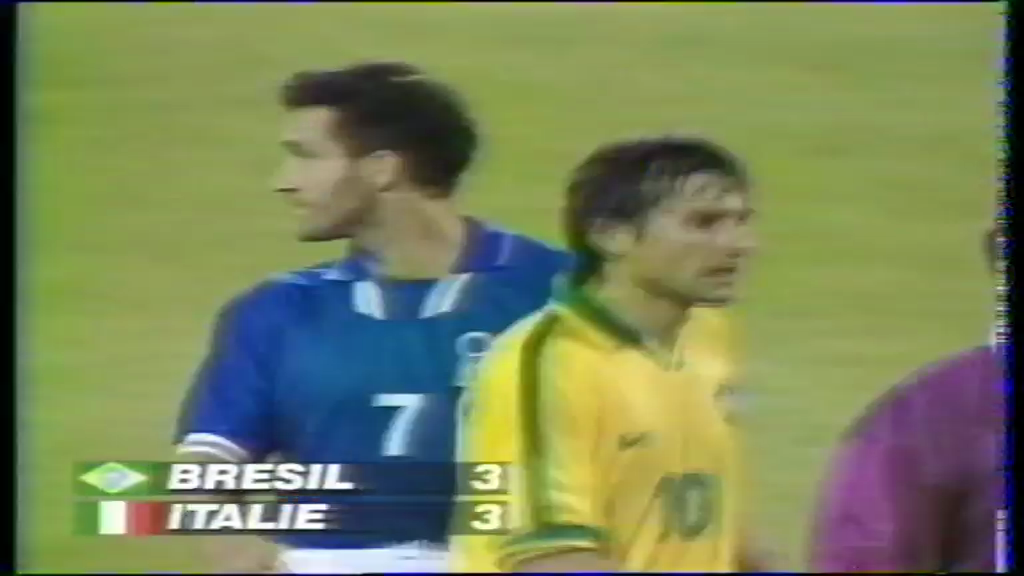
Matches of the Century: Tournoi de France 1997 Italia Brasil

Second day
8 June 1997
Stade de Gerland, Lyon

Attendance: 30,000
Referee: Serge Muhmenthaler

The most memorable match of the Tournoi de France was the 3-3 draw between Italy and Brazil, which included two goals from then 22-year-old Alessandro Del Piero and one goal apiece from Romário and Ronaldo as well as one own goal from each of the teams. Del Piero was the top goalscorer of the tournament with three goals scored while Romário scored twice.

Brasil: Taffarel - Cafu, Célio Silva, Aldair, Roberto Carlos, Mauro Silva (Flávio Conceição), Dunga, Denílson, Leonardo, Romário, Ronaldo
Italia: Pagliuca, Panucci, Cannavaro, Costacurta, Maldini (Di Livio) - Di Matteo, Albertini, Dino Baggio (Fuser), Lombardo - Vieri (Inzaghi), Del Piero


New encode
Codec H264, Mkv
French Comments
1 link by Period
Sound 160kps
Chaptered
Size 510+590mo
With 200mo Bonus
Formatted 16/9


1st half

2nd Half


Half Time


Post Match


Matches of the Century: World Cup 1954 Hungary Uruguay

Semi-Final
Stade La Pontaise, Lausanne
Wednesday, 30 June 1954 
Attendance: 37,000
Referee: Benjamin Griffiths

Overwhelming favourites to win the 1954 World Cup, Hungary arrived in Lausanne for their semi-final against Uruguay having suffered only one defeat in the preceding four years. Their opponents were defending champions, and had never lost a World Cup match in their history, winning both previous tournaments they had entered. One record had to give, and the stage was set for a match which would go down in history as one of the greatest football matches ever played.


Codec H264, Mkv
Resume 41mnts
540mo


Hungary were without their biggest star Ferenc Puskas, who had been injured in the group stages, but still started much the brighter side on a pitch left very heavy by rain earlier in the day. Just before the quarter-hour mark, a flick-on in the penalty area fell to Zoltán Czibor who placed his shot into the back of the net to give the Europeans the lead. Uruguay gradually managed to fight their way back into the game, but were unable to even the scores before half-time and went into the interval still trailing 1-0.


Almost immediately after the restart, Uruguay's grip on their title was loosened even further. Hungary seized on a poor defensive clearance and when the ball was launched into the box, Nandor Hidegkuti dived for a ball which seemed to be out of his reach and was just able to make contact with it, heading his team into a 2-0 lead. Uruguay's unbeaten World Cup record seemed to be over, but they still had nearly a full 45 minutes to recover.


The match went into extra-time, but any thoughts that the Hungarians would be demoralised by the loss of their two goal lead quickly evaporated. Appearing to have much more energy left than their opponents, Hungary retook the lead midway through the second period of extra-time when Sandor Kocsis headed home from close range. This time, the fading Uruguayans had no reply when Kocsis again got his head to a cross four minutes from time, the contest was over. Uruguay were beaten 4-2, their first ever World Cup loss, while Hungary went on to their second final where despite taking an early 2-0 lead they were surprisingly beaten 3-2 by West Germany.

Matches of the Century: World Cup 1986 Argentina England

1/4 finale
22 juin 1986
Mexico, Azteca
Arbitre : Monsieur Ben Naceur (Tunisie)
Spectateurs : 115 000


Argentine : Pumpido - Cuciuffo, Brown, Ruggeri, Olarticoechea - Gusti, Batista, Burruchaga (Tapia, 76e), Enrique - Maradona (cap), Valdano. Entr : Bilardo
Angleterre : Shilton (cap) - Stevens, Fenwick, Butcher, Sansom - Hoddle, Steven (Barnes, 76e), Reid (Waddle, 66e), Hodge - Beardsley, Lineker. Entr : Robson

Des expressions telles que "la Main de Dieu" ou "le But du Siècle", qui sont depuis rentrées dans la légende du football international, sont nées de cette rencontre épique. Nous sommes en 1986 et l'Argentine affronte l'Angleterre en quart de finale de la Coupe du Monde de la FIFA. Dans un stade Azteca écrasé par la chaleur, deux équipes aux styles et aux mentalités radicalement différentes se préparent à écrire l'une des plus belles pages de l'histoire du football.


Matches of the Century: World Cup 1954 Germany Hungary

Final
4th July 1954

Wankdorf Stadion, Bern

Attendance: 60,000
Referee: Willy H.E. Ling (England)


 West Germany: Turek, Posipal, Kohlmyer, Eckel, Liebrich, Mai, Rahn, Morlock, O. Walter, F. Walter, Scäfer
Hungary: Grosics, Buzanszky, Lantos, Boszik, Lorant, Zakarias, Puskas, Kocsis, Hidegkuti, Czibor, J. Toth
Goals: 0-1 Puskas (6), 0-2 Czibor (8), 1-2 Morlock (10), 2-2 Rahn (18), 3-2 Rahn (84)


Everyone expected Hungary to wipe the floor with Germany again and it looked to be a dead cert when they rapidly went two goals ahead. However, in remarkable scenes, the "Miracle of Bern" revealed itself to the stunned crowd. Within a ten-minute spell, the Germans had equalized through goals by Max Morlock and Helmut Rahn and had rocked the Hungarians.
The game was deadlocked until the final six minutes. After a tense moment when the Hungarians hit the post, Rahn made history by scoring the winner for West Germany after the Hungarian keeper had slipped on the turf. West Germany were World Champions for the first time.


Codec H264, Mkv
Bild Version, German

 
 or (interchangeable links)

A very confident Hungarian side ran on the pitch in Berne for the 1954 World Cup final in Berne, Switzerland: they had not lost a match in four years, and in the four previous matches to reach the final had scored a staggering 25 goals, among them, an 8-3 victory against the other finalists, West Germany, in the first round of the tournament.
In that match the Germans, under the legendary coach Sepp Herberger, had nevertheless lined almost only subsitute, not wanting to face Brazil in the quarterfinals, and also played a harsh match to injure the biggest Hungarians stars, notably Ferenc Puskas, who was unable to play until the final.
The Uruguayans in the semifinal had also shown that the mighty Hungarians could be shaken by strong fight and a solid defense, so the Germans went into the final as confident underdogs, willing to play their chance, after defeating Yugoslavia 2-0 in the quarterfinals, and destroying their Austrian brethren 6-1 in the semifinal. Among the German stars were the captain Fritz Walter, the legenderay Nüremberg striker Max Morlock, and the striker Helmuth Rahn, who was only called up by Sepp Herberger after the tournament had started.


The Hungarians decided to line up a not wholly recovered Ferenc Puskas for the final, which demanded some changes in a team that until then had been quite solid, but may have proven fatal seen in hindsight against a very solid German team.
However, none of this seemed to matter as the match (which was the first World Cup final that was transmitted live on TV) started: within eight minutes Hungary was up 2-0 on goals by Ference Puskas and Zoltán Czibor, the second goal being a huge mistake by the German goalkeeper Toni Turek.
The Hungarian goals just seemed to make the Germans better though. Within ten minutes Max Morlock and Helmuth Rahn had brought balance to the match, and the Germans dominated the rest of the first half, and things were looking good for the Germans, although nobody really thought that the Hungarians could lose!
Hungary did attack feverishly in the second half, but the Germans defended heroically, and in particular Toni Turek seemed impenetrable on the goal.


Only six minutes before the end of the match Helmuth Rahn received a return ball at the edge of the German area, made one quick move around a Hungarian defender and shot hard and flat towards the lower right goal-corner.
The German commentators screams of “TOOOOOR!” are legendary among commentators.
This remains one of the most legendary goals in German history, as it gave the West Germans the impossible victory against Hungary.
The victory meant a lot for Germans, who had been stygmatised after WWII (they had not even been allowed to participate in the 1950 World Cup), but this gave them something to be proud of, and came to symbolize the recovery of a nation. It was recreated in a 2003 German movie with huge succes, “Das Wunder von Bern” (“The Miracle of Bern”).
Germany has since remained one of the mightiest football nations in the world.


The situation was completely different for the Hungarians. The Hungary team of 1954 is arguably one of the best teams in the history of football, and surely the best team never to become world champion. Many of the players from the team had many excuses after the match, from a bad referee (who had disallowed a Puskas-goal for off-side in the dying second of the match), to drugs and black magic.
But truth is that on the day, the German fighting spirit was the best, something that is surely more important to win a World Championship.
The Hungarian “Dream Team” was soon to be dissolved because of the Hungarian Uprising of 1956, when most of the players went into exile, such as Kocsis, Puskas, Czibor. Hungarian football, that gave the world such a team, never really recovered from these events.


Les spectateurs parient que la magie des Magyars opérera une nouvelle fois et, en effet, la Hongrie mène rapidement de deux buts. Mais, en dix minutes légendaires, les Allemands renversent la vapeur. Et le meilleur reste à venir... Après une frappe sur le poteau des Hongrois, Helmut Rahn inscrit le but gagnant pour l'Allemagne à six minutes du coup de sifflet final. Il est bien aidé par le gardien hongrois, Gyula Grosics, qui glisse sur l'herbe mouillée et offre le match à la Mannschaft. Cette scène qui devait marquer l'histoire de la Coupe du Monde de la FIFA se déroulait au stade Wankdorf à Berne, le dimanche 4 juillet 1954. Pour les Allemands, cette première victoire en Coupe du Monde de la FIFA devait annoncer d'autres succès, comme l'histoire le démontra plus tard.


Reviews 

Matches of the Century: Ajax Amsterdam Bayern Munchen 1973

European Champions Cup
Quarterfinal, 1st leg 


 7 March 1973
Olympic stadium, Amsterdam
Attendance: 65000


Ajax - Stuy - Suurbier, Schilcher, Blankenburg, Krol - Haan, Muhren, Neeskens - Rep, Cruyff, Keizer -
Bayern - Maier - Hansen, Schwarzenbeck, Beckenbauer, Breitner - Zobel, Roth, Hoeness - Durnberger, Muller, Hoffmann -


In 1973, Ajax faced Bayern Munich in the 1st leg of the Quarter Finals of the European Cup. The impact of this result would not only multiply the expectation on the Dutch National Team for the forthcoming World Cup, but in five years time, at Johann Cruyff’s ‘farewell’ game, Bayern Munich would play in a not-so-friendly friendly, destroying Ajax 8-0, in an act of unmitigated revenge.


Mkv New Encoding
Codec H264
German Language
With real Chapters (Half time, Goals)

Or (Interchangeable Links) :

Pass : thewildbunch22


Ajax met Bayern (Munich) in the ¼ finals. The irony of it… it should have been the final. Both clubs played total football. The most exciting footballers at the time played for either Ajax or Bayern. Cruyff vs Beckenbauer. 


Fast, attacking football. Fun to watch. Exquisite. And also showing how great Ajax really were – Bayern were the closest thing, yet far behind. The Germans lost 0-4. Ajax rarely had opportunity to play against opposition dedicated to their own kind of football, which made them display their real qualities – and having such a chance, the Dutch were unbeatable. Perhaps their finest hour. 

 
Unstoppable Cruyff, unstoppable Ajax. The second leg was hardly important and was played differently. Tougher, less exciting match, in which Ajax preferred just to preserve their advantage. Of course, Germans never give up, but there was no way to eliminate Ajax. Bayern won 2-1 and Ajax qualified. Retrospectively, this duel proved very important: Bayern learned their lesson and never played real total football again. Instead, they changed it into something less exciting and free: they emphasized physical condition and discipline. No more fun and improvisations – just outrun the opposition, establish physical superiority, and win no matter how. Bayern killed total football and… dominated European football for many years. It was utilization of traditional German fitness combined with the vast talent of few key players. Even when winning cups, Bayern were largely tough journeymen helping few superstars. Fun they were not. Ironically, the best display of total football was the end of total football. 


 Reviews:


Le 7 mars 1973, deux cent millions de personnes ont avalé leur dîner comme on expédie une affaire courante.
Aucune d'elles n'a envie de manquer une seule seconde de la finale européenne avant la lettre Ajex-Bayern.
Certes, l'affrontement a lieu en deux manches, la première à Amsterdam, la seconde quinze jours plus tard à Muncih.
Mais il est impossible se disent ces deux cent millions de passionnés, que rien ne jaillisse des pieds de Cruyff, Keizer, Beckenbauer, Muller et consorts.
On craint cependant une féroce guerre tactique.
Les deux adversaires, en effet, ne sont pas rassurés.
Ils savent bien qu'il y aura un vaincu et que celui-ci perdra à la fois la bataille et la guerre... pour une année.
Le Bayern va jouer avec Gerd Muller handicapé par une blessure à la jambe dont on apprendra quelques jours plus tard, à la suite d'une radio de contrôle qu'il s'agit d'une fissure du péroné.
Ajax a la chance de posséder en Stefan Kovacs un remarquable tacticien.
L'entraîneur roumain se souvient qu'au cours d'un match amical l'été précédent, son équipe a battu le Bayern 5-0 et que Schwarzenbeck marquait Johann Cruyff.
Le joueur allemand a déjà déclaré qu'il ne voulait pas prendre en charge le terrible numéro 14 hollandais.
"L'ange gardien de Johann s'appellera donc Breitner ou Roth, conclut Kovacs à l'intention de ses joueurs. C'est une bonne chose pour nous dans l'un ou l'autre cas".
Quand la balle est aux Allemands, Cruyff doit suivre la recommandation de Kovacs et dresser un premier obstacle sur la route de Beckenbauer.
Si celui-ci passe, Neeskens s'approche : puis éventuellement Schilcher et Blankenburg.
Les quatre chicanes sont placées sur l'axe que le beau Franz a l'habitude d'emprunter.
Quand la balle est aux Hollandais, Cruyff doit en position d'attaque se rapprocher de Beckenbauer afin de fixer en même temps son garde du corps (Breitner ou Roth) et le capitaine munichois.
Enfin, quand le jeu emporte des demis, Haan, Neeskens et Gerrit Munhren vert le but adverse, Cruyff a la consigne de rester prudent et d'adopter une position de retrait.
Kovacs demande également à chacun de ses joueurs de "prendre en charge" un adversaire bien défini, sans pour cela le suivre systématiquement dans ses permutations.
"Vous devez rester ensemble et les obliger à faire leurs permutations devant vous et non au milieu de vous".
Ce beau "schéma directeur" générateur de grandes victoires n'eût peut-être rien donné si les impondérables de ce diable de ballon rond n'étaient venus tout bousculer.
 Pendant une mi-temps, et notamment duant la première demi-heure, Ajax tremble devant un adversaire bien organisé, lucide et entreprenant.
Non seulement le Bayern résite avec aisance aux tentatives hollandaises, mais encore il mène des offensives vives et tranchantes qui plongent dans d'embarras la défense d'Ajax. Le souvenir de cette période difficile restera si vivace dans l'esprit des joueurs hollandais qu'il combattra longtemps encore après la rencontre (4-0) la joie du triomphe.
Spectateurs et téléspectateurs ne s'y trompent pas. Ils assistent en deuxième mi-temps à une mis à mort occasionnelle provoquée à la fois par l'efficacité maximum d'un Ajax en grande réussite et par les erreurs inattendues du gardien allemand Sepp Maier.
Maier, portier de la sélection allemande championne d'Europe des Nations, est un très grand joueur.
Mais il est parfois trahi par ses nerfs ou une sortie hasardeuse. Sur les quatre buts qu'il encaisse au désespoir de Beckenbauer, deux au moins lui sont imputables. Haan (53e minute), Muhren (67e) Haan encore (69e) exécutent la danse du scalp.
Une minute avant la fin, Cruyff en personne accroche la dépouille à sa ceinture.
Ajax remporte ainsi l'une de ses plus formidables victoires. Celle-ci lui ouvre la route de la finale car on voit mal quel adversaire peut le mettre à la raison.
Et on s'interroge sur la nette supériorité des joueurs hollandais dans le domaine athlétique.
Pourquoi courent-ils plus vite et sautent-ils plus haut que leurs rivaux ? Louis Nucera propose cette formule de Napoléon à propos du football total d'Ajax : "L'art de la guerre est de disposer ses troupes de manière qu'elles soient partout à la fois."
L'Ajax allait remporter sa 3eme Coupe d'Europe en battant en finale la Juventus. (om4ever.com)